

How to Build a Realistic Personal IFAK (Not Instagram Gear) & Hemostatic Agents Compared

Most people don’t have a medical kit problem.They have a priority problem.
Too many IFAKs are built for looks, not for reality. Clean layouts, perfectly staged gear, and items that look good online, but fail when seconds matter.
A real IFAK is different.It is built around one objective:
Keep someone alive long enough to reach definitive care.
That means focusing only on what actually kills people in trauma, and ignoring everything else.
What an IFAK Is Actually For
An Individual First Aid Kit (IFAK) is not a general-purpose medical kit. It is a trauma kit for life-threatening situations.
Its purpose is simple:
Stop massive bleeding
Maintain airway and breathing
Stabilize the casualty
Uncontrolled hemorrhage remains the leading preventable cause of death in trauma, which is why every IFAK is built around bleeding control first .
The Only Framework You Need: MARCH
If your kit doesn’t follow this logic, it’s wrong.
M – Massive Hemorrhage
A – Airway
R – Respiration
C – Circulation
H – Hypothermia
Every item in your IFAK must support one of these steps.
If it doesn’t → remove it.
The Core Components (What Actually Matters)
1. Massive Hemorrhage (Priority #1)
This is where your focus must be.
Minimum:
Tourniquet (preferably 2)
Hemostatic gauze
Pressure bandage
These form a layered bleeding control system, addressing both extremity and junctional bleeding .
👉 Reality check:If you only carry one thing, it should be a tourniquet.
2. Airway & Respiration
Once bleeding is controlled, breathing kills next.
Chest seals (vented, 2x)
Optional: NPA (only if trained)
Penetrating chest trauma can rapidly lead to life-threatening complications like tension pneumothorax, which is why chest seals are standard .
3. Circulation & Support
Compressed gauze
Gloves
Tape
Trauma shears
These are not “nice-to-have”, they enable everything else.
4. Hypothermia Prevention
Often ignored. Often critical.
Emergency blanket
Hypothermia worsens shock and reduces survival, even in mild environments .
What Most People Get Wrong
❌ Mistake 1: Overloading the Kit
IFAK ≠ medical backpack.
If it doesn’t support MARCH → remove it.
❌ Mistake 2: Buying Without Training
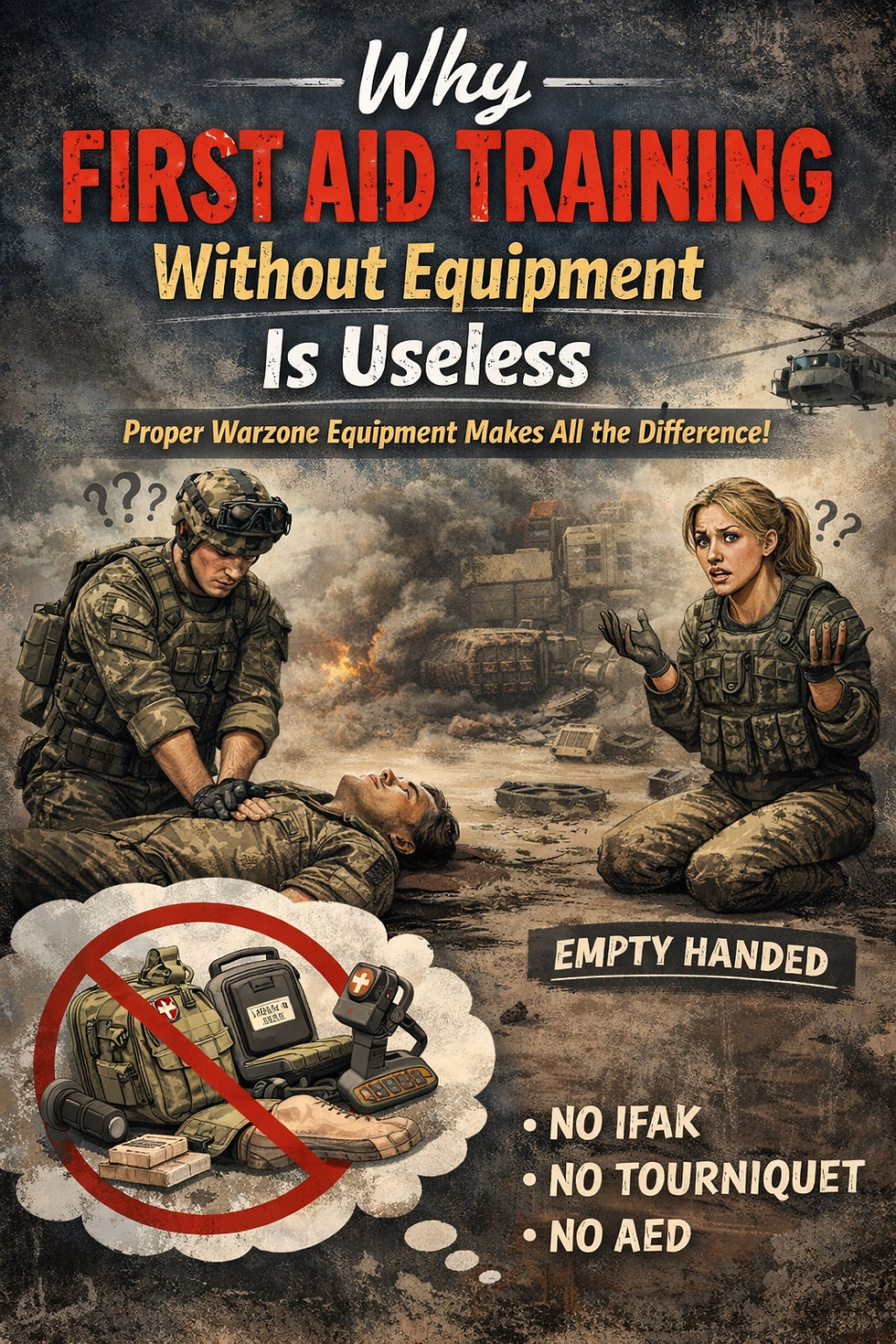
Gear without training is not just useless: it’s dangerous.
Knowing when not to act is as important as knowing how.
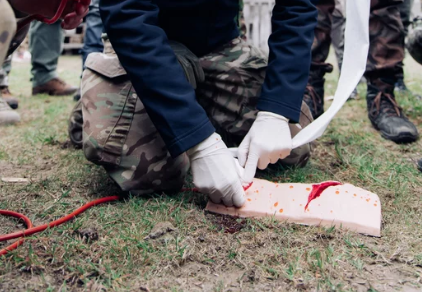
👉 This is exactly what is trained in structured environments like Lux Resilience TECC Course and advanced scenarios such as RescueX Exclusive Training.
❌ Mistake 3: Prioritizing Brand Over Function
Marketing ≠ performance.
Only use proven, field-tested components. Counterfeit or low-quality gear can fail when it matters most .
❌ Mistake 4: Poor Accessibility
If you can’t reach it with either hand under stress: It’s useless.
Building a Realistic Setup
Your IFAK should be:
Minimalist but complete
Accessible with both hands
Logically organized
Scenario-driven (EDC / Range / Travel)
This is exactly the philosophy behind:
We do not sell bling-bling Instagram or TikTok gear. We do not push “poser” equipment that looks good but fails when it matters, especially when it comes to critical components like hemostatic solutions.
We also do not pretend that low-cost gear performs at a professional level.Quality, reliability, and purpose-built design have a price, and for good reason.
Our approach is simple:
Modular setup adapted to your needs
Realistic loadout based on actual use cases
Mission-specific configuration without unnecessary compromises
Because this is not about aesthetics. And it is not about trends.
This is about equipment you rely on when lives are on the line.
Example: A Realistic Civilian Setup
A functional setup would look like this:
Core:
1–2x Tourniquet
Hemostatic gauze
Pressure bandage
Respiration:
2x Chest seals (vented!)
Support:
Compressed gauze
Gloves
Trauma shears
Additional:
Emergency blanket
No fluff. No redundancy without purpose.
The Most Important Piece of Your IFAK
It’s not the gear. It’s you.
An IFAK only works if:
you recognize the problem
you act immediately
you apply the right intervention
That requires training, not equipment:
Hemostatic Agents Compared: What Actually Works Under Pressure

Not all bleeding control solutions are created equal. While many products claim to stop bleeding effectively, their real-world performance depends on how and where they can be applied. Let’s break down the three most common options:
Hemostatic Gauze (e.g. Celox Combat Gauze)
This remains the gold standard in modern trauma care.
Why it works:
Can be packed deep into the wound cavity
Allows direct pressure at the bleeding source
Combines mechanical pressure with hemostatic action
Extensive experimental and clinical data show that wound packing with hemostatic gauze significantly improves hemorrhage control compared to standard gauze or alternative agents (Arnaud et al., 2009; Granville-Chapman et al., 2011; Kheirabadi et al., 2009).
Reality: Yes, it requires training.But it gives you control over the bleed, not just surface coverage.
👉 This is why it is the preferred solution in both civilian tactical medicine and military protocols (Butler et al., 2007; Committee on Tactical Combat Casualty Care [CoTCCC], 2021).
Chitosan Powder (e.g. products like Rhino Rescue)
At first glance, powder seems simple and fast. In reality, it has a critical limitation:
Problem:
It is primarily applied on the surface
It does not reliably reach deep bleeding vessels
Studies on granular and powder-based hemostatic agents show reduced effectiveness in deep or junctional hemorrhage when adequate wound packing and pressure are not achieved (Kheirabadi, 2011; Wedmore et al., 2006).
This makes it largely ineffective for:
Deep wounds
Junctional hemorrhage
High-pressure arterial bleeding
👉 In short: it treats what you see, not what is killing the patient.
Hemostatic Syringe (Injectable Agents)
This concept aims to solve the depth problem by delivering hemostatic agents directly into the wound.
Advantages:
Better reach than powder
Faster application than gauze (in theory)
Limitations (as shown in literature):
Can create an artificial cavity or channel
This may prevent effective pressure on the bleeding vessel
Leads to inconsistent hemorrhage control in real-world models
Experimental studies on injectable hemostatic agents highlight variability in effectiveness, particularly due to inadequate pressure generation and suboptimal distribution within the wound tract (Kheirabadi et al., 2010; Rall et al., 2013).
Bottom Line
When it comes to life-threatening bleeding:
Powder is superficial
Syringes are inconsistent
Gauze is effective
Hemostatic gauze works because it combines:
Depth
Pressure
Control
Yes, it requires proper training.But it is the only option that allows you to treat the problem at its source, consistent with modern trauma care principles (American College of Surgeons, 2018; CoTCCC, 2021).
Call to Action
If you want to move beyond theory:
Build your setup with the
in addition with the
Learn how to actually use it in
or take it further with
Because in the end:
Preparedness is not what you carry. It’s what you can do under pressure.
Conclusion
A realistic IFAK is not impressive. It is efficient, brutal, and focused.
It is built around one idea:
Solve the problems that kill first, nothing else.
If your kit can:
stop massive bleeding
support breathing
buy time
Then it works. If not, rebuild it!
References
Butler, F. K., Holcomb, J. B., & Giebner, S. D. (2007). Tactical combat casualty care 2007: Evolving concepts and battlefield experience. Military Medicine, 172(11), 1–19.
Committee on Tactical Combat Casualty Care (CoTCCC). (2021). TCCC Guidelines for Medical Personnel.
American College of Surgeons. (2018). Stop the Bleed Campaign: Instructor Guide.
Arnaud, F., Parreno-Sacdalan, D., Tomori, T., et al. (2009). Comparison of 10 hemostatic dressings in a groin transection model in swine. Journal of Trauma, 67(4), 848–855.
Kheirabadi, B. S., et al. (2009). Comparison of new hemostatic granules/powders with standard gauze in a severe hemorrhage model. Journal of Trauma, 66(2), 316–328.
Granville-Chapman, J., Jacobs, N., & Midwinter, M. (2011). Pre-hospital haemostatic dressings: A systematic review. Injury, 42(5), 447–459.

Comments