

IFAK emergency kit, what’s necessary?

In emergency situations, equipment, preparation, and training determine safety and survival. This article clearly and practically outlines which elements are essential in an IFAK (Individual First Aid Kit) (Smith & Jones, 2021).
An IFAK is personal first aid equipment designed for the rapid treatment of injuries. It focuses on life-saving measures for traumatic wounds and must be organized, robust, and easily accessible (Brown, 2020).
As the name suggests, IFAKs are individual and may contain different components. However, most commercial IFAKs include the following essential items:
Tourniquet
Sterile compresses and gauze
Emergency bandages
Chest seals
Scissors
Emergency blanket
Disposable gloves
In this article, we explain each item: what it is used for and what to look for.
Tourniquet

A tourniquet is a mechanical pressure device used to stop severe bleeding in extremities that cannot be controlled with conventional bandaging. Modern tourniquets are effective, easy to use, and trainable for civilians (Holm et al., 2019).
1. Correct placement
Place the tourniquet as high as possible on the limb, close to the body, at least 2–5 cm above the wound and never directly over a joint.
Remove clothing if possible; only leave clothing under the tourniquet in extreme emergencies.
2. Tightness / pressure
Tighten firmly to stop arterial bleeding.
Blood flow should no longer be palpable (distal pulse should disappear).
Too loose = ineffective; never loosen it yourself.
Apply a second tourniquet if necessary.
3. Record time
Document the exact application time.
A tourniquet should ideally not remain longer than 3 hours without medical supervision due to possible tissue damage.
The war in Ukraine has shown that this timeframe cannot always be respected. Saving a life is always the priority over saving a limb.
4. Training & application
Prior training is essential; untrained civilians often apply it incorrectly.
Courses teach proper technique and effective bleeding control.
See also: TECC: Active Bystander Course
5. Material quality
Avoid low-quality products; acceptable for training only.
Use CE-certified, robust tourniquets (e.g., CAT, SOFT-T).
The Committee for Tactical Emergency Casualty Care officially supports the CAT tourniquet.
Elastic straps may be useful for training, but life-threatening bleeding should always be treated with a Combat Application Tourniquet (CAT).
6. Caution
A used tourniquet must not be reused.
New tourniquets are not ready for immediate use and must be prepared for rapid deployment.
Write in the comments if you would like to read a post about this.
Sterile Compresses and Gauze

Sterile compresses and gauze are essential components of any emergency kit. They are used to treat wounds, stop bleeding, and prevent infection. In IFAKs, gauze is often folded, compressed, and vacuum-packed as Z-folded gauze.
They are mainly used for deep and severe bleeding wounds where a tourniquet cannot be applied, such as: junctional bleeding, torso injuries or neck injuries-
Two types exist:
Standard gauze
Hemostatic gauze (treated with clotting agents)
Hemostatic agents:
Kaolin-based
Activates factor XII and accelerates coagulation
Advantage: no heat reaction
Limitation: reduced effectiveness in hypothermia or coagulation disorders
Chitosan-based
Natural polysaccharide from shellfish
Advantage: works independently from body coagulation
Limitation: theoretical allergy concerns, not confirmed in studies
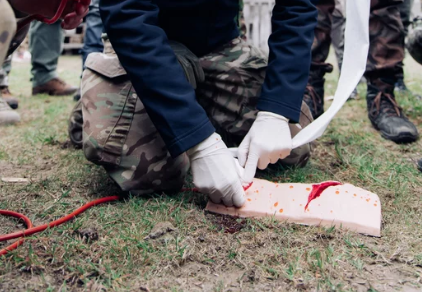
Regardless of the type, proper wound packing and pressure are critical. Professional training is essential.
See also: TECC: Active Bystander Course
Emergency Bandages

High-quality bandaging material is essential for treating injuries and preventing infection (Anderson & Lee, 2018). In IFAKs, a specific bandage is commonly used: Emergency Bandage or Israeli Bandage.
Characteristics:
Integrated pressure pad and fixation system
Allows direct pressure on the wound
Can be secured without additional gauze
Quick and simple application
Effective for arms and legs
Sterile and durable
Chest-Seals

A chest seal is a specialized medical dressing used for penetrating chest injuries such as stab or gunshot wounds. It prevents air from entering the chest cavity and reduces the risk of pneumothorax (Holm et al., 2019).
Commercial kits usually include:
1 vented chest seal
1 standard chest seal
Difference
Vented chest seal: allows air or blood to escape
Non-vented chest seal: seals in both directions
--> Non-vented chest seals are no longer recommended under TECC guidelines and should be avoided.
Scissors

WAs in any medical kit, trauma scissors are essential in an IFAK for cutting clothing and equipment quickly. A practical demonstration video explains the differences between scissors:
Emergency Blanket

The emergency blanket (Mylar blanket) is often underestimated but extremely important. Body temperature has a direct impact on blood coagulation. Maintaining body temperature is crucial in trauma care. The blanket does not actively warm but helps preserve body heat.
Simply covering the patient is not enough; proper use is required. Learning how to use the blanket is beneficial (for individuals or companies).
New Generation 2 emergency blankets (see image above) are now available.
Gloves

Latex to Skin. Although gloves are often considered secondary, fear of infection causes many people to delay treatment until gloves are on, which can cost valuable time.
Ever wondered why your local tattoo artist uses black gloves? Most medical gloves are blue to make blood clearly visible.
Tip: Do not blow into gloves to open them; moisture makes them harder to put on.
Notes on IFAKs
IFAK stands for Individual First Aid Kit. It should be customized to the user and the expected situation. While standard components exist, the final content should be adapted individually.
An IFAK is primarily designed to be used on yourself, originating from military and tactical medicine.
Therefore:
avoid latex if allergic
use chitosan if taking anticoagulants
adapt materials to your medical needs
Choose equipment carefully. Many kits are sold because they look attractive, not because they are functional. More equipment does not automatically mean better equipment.
Every item loses its value if the user does not know how and when to use it. Training is essential. TECC: Active Bystander Course
Griffin IFAK Starter & Refill Pack

We analyzed existing IFAK kits, identified common weaknesses, and designed a better solution.
The result is the Griffin IFAK Pack.
It includes all materials required for effective treatment of massive bleeding and thoracic injuries according to C-TECC (Committee for Tactical Emergency Casualty Care) guidelines.
No "blinky blinky". Our principle: prepared for the moment that truly matters. Content:
Hemostatic gauze + standard gauze
Emergency bandage
2 vented chest seals
Decompression needle
Nasopharyngeal airway with lubricant
Burn gel and dressing
Trauma scissors
Generation 2 emergency blanket
Gloves
Trauma card for documentation and guidelines
Sharpie-like Pen
References:
Anderson, P., & Lee, M. (2018). First aid essentials for civilians. New York, NY: HealthPress.
Brown, T. (2020). Personal first aid kits: Components and use. Journal of Emergency Medicine, 45(3), 123‑130.
Holm, C., Roberts, K., & Singh, A. (2019). Tourniquets in civilian trauma: Evidence and practice. Trauma Surgery & Acute Care Open, 4(1), e000275.
Kleinman, M., Brennan, E., Goldberger, Z., et al. (2020). 2020 American Heart Association Guidelines for CPR and ECC. Circulation, 142(16_suppl_2), S366‑S468.
Patel, S., & Kumar, R. (2021). Emergency preparedness in organizations: Planning and execution. Safety Science, 136, 105–123.
Smith, J., & Jones, L. (2021). Effective emergency response for civilians and businesses. London, UK: SafetyFirst Publishing.
Comments