

Why First Aid Training Without Equipment Is Useless.

( 2min read)
In recent years, first aid has developed significantly: moving away from simple bandages and plasters toward life-saving concepts that combine training with appropriate equipment.
Training without equipment is like skydiving without a parachute. Knowledge alone is not enough to reliably care for a critically injured person, and without practical application of the equipment, good knowledge quickly turns into ignorance in an emergency.
1. Theory alone does not stop life-threatening bleeding
A classic first aid course teaches important basic knowledge, but often only fundamental measures like pressure bandages or the recovery position. Severe arterial bleeding, on the other hand, can become life-threatening within minutes. Without specialized equipment such as tourniquets or hemostatic gauze, you lack effective tools to manage these situations.
2. Equipment enables effective action
An IFAK (Individual First Aid Kit) contains specialized tools such as:
Tourniquet, for controlling severe extremity bleeding
Hemostatic gauze, to support blood clotting
Chest seals for treating thoracic wounds
Decompression needles to relieve tension pneumothorax
And more
Without this equipment, the theory you have learned cannot be effectively applied in practice, especially when seconds can mean the difference between life and death.
See also: IFAK emergency kit, what’s necessary?
3. Training alone is not enough – practical application matters
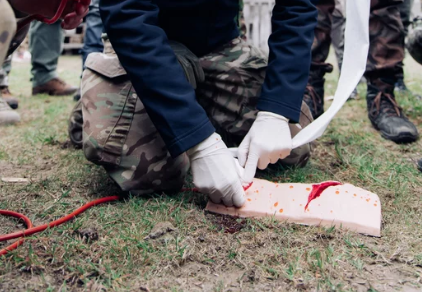
Knowing where a tourniquet should be placed is important—but how quickly and safely you apply it determines the outcome in a real emergency. Only through regular practical exercises with the same materials you would use in an actual incident do you develop the necessary confidence and speed. Many people own an IFAK but do not know how to use it correctly under stress.
See also: TECC - Active Bystander Course
4. Improvisation is risky in emergencies
In theory, a tourniquet can be improvised (e.g., with a belt), but such solutions are often ineffective or even harmful if applied incorrectly. Professional equipment is designed for effective pressure application, minimizes errors, and significantly improves survival chances (IFRC, 2025).
Conclusion
First aid training without matching equipment is only half the preparation. Truly capable responders are those who not only know what to do but also know which tools to use and how to use them. Only then can a response in critical minutes be transformed into a real rescue.
Check out: Disaster Health Institute
References
Lux Resilience. (n.d.). Stopping severe bleeding: Proper use of tourniquets and IFAKs. Lux Resilience. https://www.luxresilience.com/post/stopping-severe-bleeding-proper-use-of-tourniquets-and-ifaks
Lux Resilience. (n.d.). IFAK emergency kit, what’s necessary? Lux Resilience. https://www.luxresilience.com/post/ifak-emergency-kit-what-is-necessary
International Federation of Red Cross and Red Crescent Societies. (2020). Guidelines for first aid in emergencies. IFRC. https://www.ifrc.org/sites/default/files/2022-02/EN_GFARC_GUIDELINES_2020.pdf

Comments