

5 Common Mistakes Across the MARCH Assessment

Updated: 4 days ago

MARCH is a way to organise priorities when dealing with serious trauma. It stands for Massive Bleeding, Airway, Respiration, Circulation, and Hypothermia. Some versions also include head injury under the final [H]. The exact wording can vary, so follow the version taught in your course.
MARCH was developed for trauma care. It is not a replacement for calling emergency services, and it does not mean that every bystander should perform every possible intervention. Use only the skills you have been trained to use.
While the number of people trained in TECC continues to grow, five common mistakes are still made when applying the MARCH algorithm. The following are the most frequent errors I have encountered.
Mistakes When Managing Massive Bleeding
1. Not addressing massive bleeding immediately
One of the biggest mistakes is losing valuable time before addressing a life-threatening bleed. Massive bleeding needs to be recognised and treated immediately. Do not delay bleeding control while dealing with less urgent injuries or conducting a lengthy assessment.
ABCDE vs. MARCH
2. Not having the tourniquet or gauze readily accessible

Having the right equipment is only useful if you can reach it quickly. Tourniquets and wound-packing gauze, whether haemostatic or standard, should be immediately accessible, rather than buried inside a backpack, stored in an inaccessible compartment, or carried in a pouch that is difficult to reach under stress.
Your IFAK setup should allow rapid access to your bleeding-control equipment.
Dedicated solutions such as the Griffin IFAK Pouch (currently sold out, back soon) and Griffin Tourniquet Pouch (currently sold out, back soon) can help keep critical equipment immediately available when seconds matter.
3. Packing the wound without reaching the source—and without applying sufficient pressure
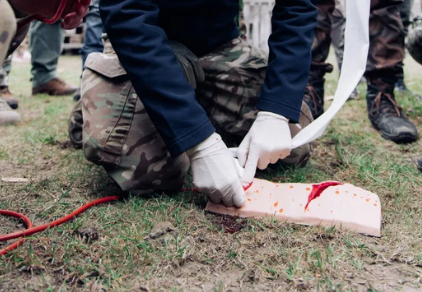
Simply placing gauze into a wound is not enough. When wound packing is indicated,
the gauze needs to be packed firmly and appropriately to reach the source of the bleeding, according to your training.

Pressure is equally important. Maintain firm, sustained pressure during and after packing to help control the bleeding. Loose packing or insufficient pressure can allow the bleeding to continue.
4. Failing to reassess the bleeding
Stopping the initial bleeding is not the end of the intervention. The wound needs to be reassessed to make sure the bleeding remains controlled.
If bleeding continues or returns, take action according to your training and the equipment you are using. Continue monitoring the casualty and communicate any deterioration to emergency services.
5. Failing to maintain the tourniquet, and releasing it because the casualty asks

A tourniquet can be painful, and a conscious casualty may ask you to loosen or remove it. Do not release or loosen a tourniquet simply because the casualty asks you to.
Once a tourniquet has been appropriately applied for life-threatening bleeding, maintain it according to your training and local protocol until the casualty reaches definitive medical care. Removing or loosening it can allow severe bleeding to restart.
The key message
Act immediately. Keep your equipment accessible. Apply the technique correctly. Reassess. And once a life-saving intervention is in place, maintain it.
Mistakes When Managing the Airway
1. Forgetting the [A] and moving directly from [M] to [R]
A common mistake is to see an obvious chest or breathing problem and move straight from Massive Bleeding [M] to Respiration [R].
The airway must still be assessed. A casualty can have a serious respiratory problem because the airway is obstructed, and failing to recognise this early can delay a potentially life-saving intervention.
MARCH is a sequence of priorities, not a list of steps to skip when another problem looks more obvious.
2. Failing to recognise airway obstruction
An airway problem is not always obvious. Noisy, abnormal, or ineffective breathing, unusual sounds, reduced responsiveness, or difficulty maintaining the airway can be warning signs.
Do not focus only on whether the casualty is breathing. Assess whether the airway is actually patent and whether the casualty can maintain it.
3. Hesitating to use an NPA when it is indicated
Some responders hesitate to use a nasopharyngeal airway (NPA) because it looks uncomfortable or “invasive.” This hesitation can delay airway management.

When an NPA is appropriate and its use is within your training and local protocol, it is a basic airway adjunct designed to help maintain airway potency. Use the correct size and insertion technique, and be aware of contraindications taught in your training.
Note: The TCCC & TECC guidelines do not include the use of an NPA.
4. Performing an airway intervention and then failing to reassess
Placing an airway adjunct is not the end of the assessment. The casualty's condition can change, and an airway that was initially adequate can deteriorate.
After any airway intervention, continue to monitor responsiveness and breathing and reassess if the casualty's condition changes.
5. Failing to consider the airway when the casualty becomes less responsive
A casualty who becomes increasingly confused, drowsy, or unresponsive may lose their ability to protect their own airway.
Do not assume that a change in consciousness is simply part of “shock.” Reassess the airway and breathing immediately, and follow your emergency-service protocol. If the casualty becomes unresponsive and is not breathing normally, initiate the appropriate emergency response and follow the instructions from the dispatcher.
The key message
Do not let an obvious injury make you skip the airway. Recognise obstruction early, use appropriate airway adjuncts when indicated and within your training, and reassess continuously.
Mistakes When Assessing Respiration
After addressing massive bleeding and the airway, the next priority is [R] Respiration. Thoracic trauma can deteriorate rapidly, so a systematic assessment and regular reassessment are essential.
1. Not performing a thorough check for an entry wound
A penetrating chest injury can be easy to miss, particularly when there are multiple injuries or when the casualty is wearing clothing.
Perform a systematic assessment of the chest and look carefully for potential entry wounds. Do not assume that the most obvious wound is the only injury.
2. Not correctly evaluating the physiology of respiration
Simply confirming that the casualty is breathing is not enough. Assess how they are breathing.

Look for signs such as unequal chest movement, difficulty breathing, abnormal respiratory rate or effort, and reduced or absent movement on one side. One-sided or significantly unequal breathing can indicate a serious chest injury and requires urgent medical attention.
3. Applying a chest seal to the entry wound but failing to check for an exit wound
A penetrating injury can create both an entry and an exit wound. Treating only the obvious wound can leave an additional opening untreated.

When assessing a penetrating chest injury, check the front, sides, and back of the chest for additional wounds. If a chest seal is indicated, make sure all relevant open chest wounds are appropriately addressed according to your training and the product instructions.
4. Failing to reassess regularly
A casualty with a chest injury can deteriorate quickly. A person who initially appears stable may develop increasing respiratory distress.
Do not consider the assessment finished once a chest seal has been applied. Continue to monitor breathing, chest movement, responsiveness, and the casualty's overall condition, and be prepared to act if their condition changes.
5. Not having the appropriate equipment available
Your kit should contain the equipment appropriate to your level of training and intended use.
For open chest wounds, use a vented chest seal in accordance with your training and the manufacturer's instructions. Equipment that is unsuitable for the intended intervention can delay appropriate treatment.
For professional responders, appropriate protocols may also require equipment for advanced interventions such as needle decompression. Such procedures should only be performed by personnel who are specifically trained, authorised, and equipped to do so.
The key message
Find the injury. Assess how the casualty is breathing. Check for entry and exit wounds. Treat appropriately. Then reassess continuously.
Mistakes When Assessing Circulation

Once massive bleeding, airway, and respiration have been addressed, [C] Circulation focuses on identifying problems that can compromise the casualty's ability to maintain adequate circulation. A casualty does not need to have an obvious external bleed to be in serious trouble.
1. Assuming there is no circulation problem because no blood is visible
The absence of visible bleeding does not mean that circulation is adequate. Serious blood loss can be hidden, and a casualty can deteriorate without obvious external bleeding.
Perform a thorough assessment rather than simply looking for blood. Continue to monitor responsiveness, skin condition, and other signs of deterioration, and communicate significant changes to emergency services.
2. Ignoring bleeding because it is not “massive”
Not every wound will produce catastrophic bleeding, but multiple smaller wounds can add up to significant blood loss.
Treat bleeding according to your training, even when no individual wound appears immediately life-threatening. A casualty with numerous wounds can lose a substantial amount of blood over time.
3. Failing to address other injuries that can affect circulation
Circulation can also be affected by injuries that do not initially appear to be a circulation problem.
Burns can result in significant fluid loss, while fractures, particularly major fractures, can be associated with substantial internal blood loss and can also cause severe pain and physiological stress.
Do not focus exclusively on visible bleeding. Identify and appropriately manage other significant injuries within your level of training.
4. Failing to reassess circulation
A single assessment is only a snapshot. A casualty's condition can deteriorate over time, particularly after major trauma.
Continue to monitor for changes such as increasing weakness, altered responsiveness, pale or clammy skin, worsening pain, or changes in breathing. Regular reassessment is essential because deterioration may be gradual and easy to miss.
5. Failing to protect the casualty from further deterioration
Once immediate threats have been addressed, do not leave the casualty exposed unnecessarily. Preventing further heat loss is an important part of trauma care, because hypothermia can worsen the casualty's condition and interfere with normal clotting.
Protect the casualty from cold, wind, rain, and contact with the ground while continuing to monitor them and waiting for emergency medical care.
The key message
No visible blood does not mean no circulation problem. Check thoroughly, treat all significant bleeding and injuries within your training, reassess regularly, and prevent further deterioration.
Mistakes When Managing Hypothermia
Hypothermia is not simply a problem of comfort. In trauma, heat loss can contribute to a dangerous downward spiral and can impair the body's ability to form effective clots. Preventing and treating hypothermia is therefore an important part of trauma care.

1. Underestimating the importance of hypothermia
A common mistake is to treat hypothermia as a secondary concern that can be addressed once everything else has been dealt with.
In trauma, this can be dangerous. Hypothermia can directly impair the body's clotting mechanisms, making it harder to control bleeding and potentially contributing to a worsening cycle of blood loss and physiological deterioration.
The aim should therefore be to prevent unnecessary heat loss from the beginning, not to wait until the casualty is visibly cold.
2. Not correctly applying the emergency blanket

Simply placing an emergency blanket over the casualty is not always enough. The casualty should be wrapped and protected as effectively as possible, while keeping access to injuries and medical equipment when necessary.
Pay particular attention to exposed areas and gaps through which heat can be lost. The blanket should be used as part of an overall insulation strategy rather than as a simple cover.
3. Forgetting to insulate the casualty from the ground
Covering the casualty from above while leaving them directly exposed to a cold surface is a common oversight.
4. Failing to protect the casualty from the environment

Wind, rain, and wet clothing can dramatically increase heat loss. A casualty who is already injured and lying still may become hypothermic surprisingly quickly.
When safe to do so, shield the casualty from wind and precipitation, remove or replace wet clothing when appropriate, and keep them as dry and insulated as possible. Continue monitoring them while waiting for medical assistance.
5. Using a first-generation emergency blanket without considering its limitations

This is not necessarily a mistake, but equipment choice can have consequences.
Traditional first-generation emergency blankets can be very noisy, particularly when moved. In a stressful situation, this can make verbal communication more difficult: the casualty may struggle to hear the responder, while the responder may have difficulty hearing a weak or absent response from the casualty.
Where possible, choose equipment that provides effective thermal protection without
unnecessarily interfering with communication and monitoring.
The Griffin IFAK | Starter & Refill Pack consists of a carefully selected combination of high-quality, next-generation materials.
The key message
Do not wait for the casualty to become visibly cold. Prevent heat loss early, insulate them from above and below, protect them from the environment, and keep communication and monitoring possible.
Hypothermia prevention is an integral part of trauma care, not an optional final step.
You can practise MARCH under supervision in our TECC course in Luxembourg.


Comments