

First Aid vs TECC: Concepts with Clear Added Value

A 16-hour First Aid course and a TECC Active Bystander course pursue different goals and address different operational situations. Both have their strengths – First Aid vs TECC: combined (e.g., in the RescueX concept) they become particularly effective.
Content of the 16-hour First Aid Course
The classic 16-hour First Aid course, as offered by Lux Resilience and recognized by the Luxembourg Ministry of the Interior, provides a broad foundation of life-saving immediate measures for everyday emergencies.
This includes, among other things:
Emergency management on site and standardized emergency calls
Unconsciousness & recovery position
Cardiopulmonary resuscitation (CPR) and AED use
Handling bleeding, wounds, and dressings
Injuries such as burns or bone fractures
Medical emergencies such as hypoglycemia or intoxication
The goal is the safe application of immediate measures until professional rescue personnel arrive. The course teaches practical techniques that are frequently needed in everyday situations and concludes with an official diploma valid for five years.
See also:
Content of the TECC Active Bystander Course
The TECC (Tactical Emergency Casualty Care) Active Bystander approach prepares participants for medical emergency measures in dangerous or dynamic scenarios – for example, active violence or mass casualty events.
According to C-TECC guidelines, this includes:
Principles of tactical emergency management in direct threat situations
Situational awareness and decision-making under risk
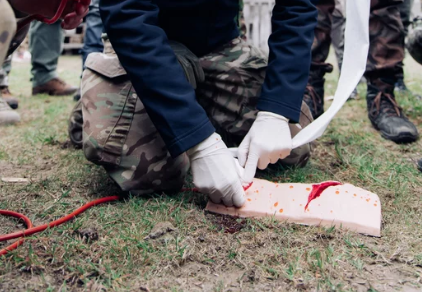
Control of severe bleeding, including tourniquet and pressure bandage application
Basic techniques for airway and circulation management
Focus on rapid, life-saving measures until evacuation or handover to professional rescue teams
While classic First Aid is often based on a “safe environment,” TECC teaches how to respond under stress, in hazardous environments, and before external help arrives – bridging the time when professional systems are not yet available or are limited.
See also: TECC-Active Bystander Course
Strengths and Goals Compared
Aspect | 16-hour First Aid Course | TECC Active Bystander |
Focus | Everyday emergencies, safe environment | Threat scenarios, dynamic risks |
Target Group | General public, everyday first responders | Citizens in dynamic scenarios, active bystanders |
Learning Objective | Apply immediate measures correctly | Life-saving immediate measures under risk |
Practical Relevance | Everyday situations | High-risk / complex emergencies |
Duration | Standard (16 h) | Variable (often shorter, modular |
Limits to the Algorithm | Minutes pass until you would address critical bleeding | Does not apply to unalive persons. |
Benefits Depending on the Situation
1The 16-hour First Aid course forms the foundation for handling most emergencies encountered in daily life – from unconsciousness to accidents to cardiovascular emergencies. It is a legal standard and recognized in most countries.
TECC Active Bystander goes further: it trains not only medical measures but also behavior in hazardous environments, threat assessment, and adaptation of tactics to dynamic situations. This is particularly important in events involving violence, mass casualties, or scenarios where standard first responder tactics are insufficient.
Conclusion: Both Courses Make Sense (RescueX)
Both course models serve clear but different purposes.
The 16-hour First Aid course is the basis for confident action in everyday life. The TECC Active Bystander course complements this knowledge with situation-specific, tactical skills under threat.
In combination – as in the “RescueX” approach – a wide spectrum of life-saving competencies is covered: from classic First Aid to advanced measures in critical, dangerous situations.
This combination enables participants to act effectively across a broader range of emergencies, handling both everyday and high-risk scenarios more safely.
See also: RescueX Course
References
Committee for Tactical Emergency Casualty Care (C‑TECC). (2024). TECC Guidelines for Active Bystanders.
Comments