

10 Priorities for Assembling Tactical Gear

Aktualisiert: 3. Aug.

Anyone involved in tactical gear, shooting sports, or professional security equipment will sooner or later realize that not every piece of equipment holds the same importance. Too often, minor items are prioritized while the truly essential components are neglected.
Here are my personal top 10 priorities for assembling tactical gear.
I’d love to discuss this list with you. Do you have different priorities? Share them with me in the comments.
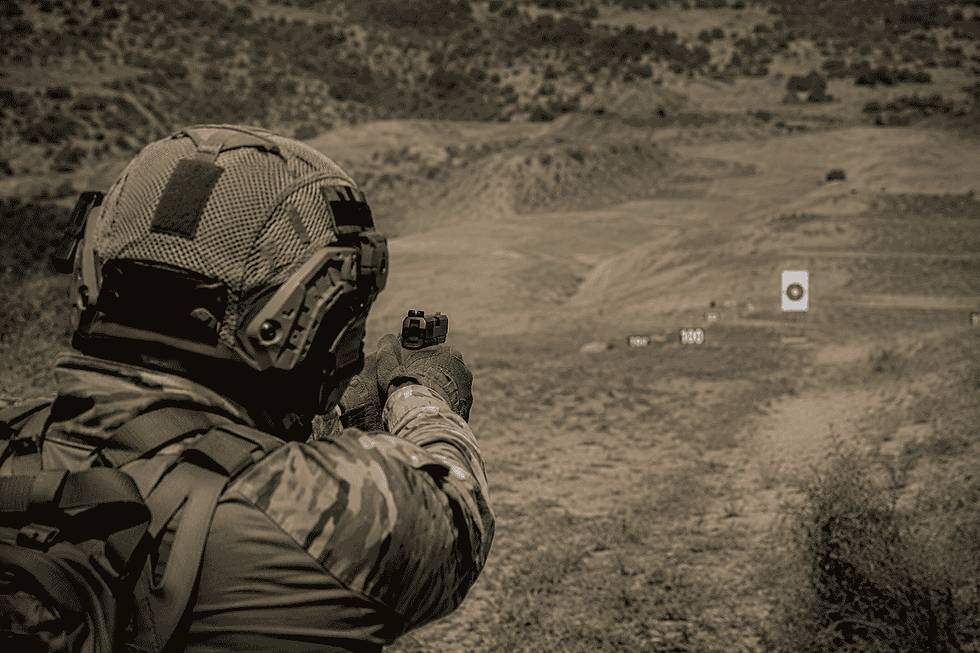
1. Weapons: Primary and, if necessary, secondary weapon
At the top of the list is, of course, the weapon itself. The choice of a primary weapon should always be tailored to the intended mission or role.
Not every role has the same requirements. A platform that makes sense for a precision shooter will differ significantly from one optimized for close-range engagements or from the equipment carried by a medical support operator. Your gear should support the mission, not the other way around.
A common mistake is selecting equipment based on trends or personal preferences rather than the actual operational profile. A suitable, reliable, and familiar weapon is far more important than the latest accessories.
The secondary weapon is often considered indispensable. In reality, however, its necessity depends heavily on the intended use. In scenarios that exclusively involve longer engagement distances, or where the primary weapon remains available at all times, a pistol may simply add unnecessary weight and consume valuable space. A secondary weapon should therefore be included deliberately, not automatically.
2. he IFAK: Safety Above All
Right after the weapon comes, for me, the IFAK (Individual First Aid Kit).
It does not matter whether you are operating in a professional environment, participating in shooting sports, or attending training events. Anyone working with weapons should carry an IFAK and, most importantly, know how to properly use its contents.
The best medical equipment is useless if no one knows how to apply it. Regular training and hands-on practice are therefore just as much a part of the equipment as the IFAK itself.
3. Self-Protection: Helmet and Plate Carrier
Personal protection ranks third.
A high-quality plate carrier and a reliable ballistic helmet are among the most important components of personal protective equipment. One should never rely solely on marketing claims.
With low-cost imported products, it is often evident that the actual level of protection does not always match the stated specifications. Some plate carriers may indeed offer a certain level of protection against handgun ammunition. However, this does not automatically mean that all advertised protection classes are actually met.
I am particularly critical of many low-cost ballistic helmets. In this area, only verifiable certifications, independent testing, and trusted manufacturers should be relied upon.
This ballistic helmet from TEMU was shot at from 20 meters with 9×19 mm Parabellum and .223 Rem ammunition (FMJ).
(Photo by LuxResilience)
4. Holster and Tourniquet
A good holster is not only used for securely carrying a pistol.
Nowadays, there are many systems that integrate a tourniquet directly into the holster. This keeps life-saving equipment immediately accessible without taking up additional space on the belt or plate carrier.
The most important factor is that the tourniquet is both quickly reachable and securely fastened.
Experiences from modern conflicts and the tactical field have clearly shown one thing: a single tourniquet is often not enough.
Many users focus on carrying just one tourniquet, but they often overlook an important point: equipment can be lost, damaged, or difficult to access in certain situations. Therefore, one should not rely solely on a single tourniquet.
For this reason, many experienced users rely on redundancy. Tourniquets are distributed across different positions on the gear (see Lux Resilience Iron Clad 2-Point Sling ), providing multiple options when needed. This also allows supporting others if they have lost their equipment or don’t have one immediately available.
Personally, I never leave the house with only one tourniquet. Multiple tourniquets take up very little space, weigh almost nothing, and have now become part of my standard loadout. If I have extra space on my gear, there is usually room for an additional tourniquet.
The old rule “one is none, two is one” applies especially here. With life-saving equipment, redundancy is not a luxury, it’s a smart precaution.
5. Proper Clothing
Clothing is often underestimated.
Those who only train for a few hours may hardly notice minor discomforts. However, anyone who spends a full day or even several days in their gear will clearly feel every poorly fitting hem, every chafing seam, and every uncomfortable pocket.
Even the best equipment is of little use if the clothing is constantly distracting or causing discomfort. That is why clothing should be durable, functional, and above all comfortable.
6. Appropriate Footwear
After clothing comes footwear.
Many people focus exclusively on weapons, load-bearing systems, or clothing and forget that it is ultimately the feet that carry and move all the equipment.
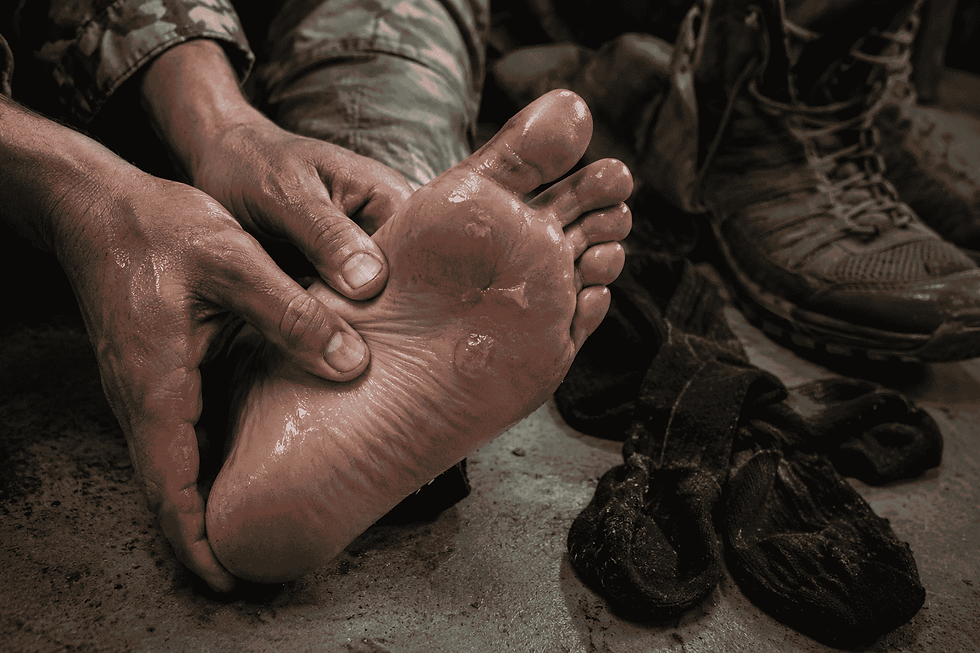
Inadequate footwear can cause blisters, pressure points, and fatigue. Good boots support the foot, provide stability, and ensure a high level of comfort even over extended periods.
7. The Right Socks: More Important Than Many Think
Just as important as footwear are socks.
They form the direct interface between foot and shoe and have a major impact on overall comfort. High-quality socks must reliably wick moisture away from the foot and create a comfortable foot climate.
The Lux Resilience Atlas Guard Performance Socks as well as the Atlas Guard Operator Series Socks were developed specifically for this purpose through multiple stages of refinement. Our concept deliberately differs from many traditional moisture management systems.

Instead of transporting moisture directly into the footwear, it remains controlled within the sock. The reason is simple: socks can be easily changed, whereas shoes cannot.

Dry footwear is significantly more important in the long term than dry socks. Once the inside of the shoes becomes persistently damp, even frequent sock changes only help to a limited extent.
For this reason, I generally recommend planning multiple pairs of socks for each day. They take up hardly any space, weigh almost nothing, and can be aired or changed throughout the day. This significantly improves comfort, hygiene, and foot health.
8. Water and Hydration
Performance begins with adequate fluid intake.
Many people invest significant sums in equipment and, in the process, forget the simplest prerequisite for concentration and physical performance: sufficient water.
Hydration systems or water bottles should therefore always be part of the basic equipment.
9. Communication
Communication is often reduced to radios. In reality, however, it is much more than just the ability to talk to each other via radio.
Of course, a reliable means of communication is part of the basic equipment. Equally important, however, are the correct selection of the system, proper setup, and above all regular training. The best radio is useless if its operation cannot be mastered under stress.
However, communication does not only take place via radio. In tactical environments in particular, non-verbal forms of communication play a crucial role. Visual contact, hand signals, head movements, and pre-established signals enable silent coordination and prevent unnecessary attention.
Especially at night or in situations where verbal communication is not possible or practical, this form of communication becomes indispensable. Those who rely solely on technology overlook a key component of successful teamwork.
Communication is therefore far more than a radio on a plate carrier. It begins with shared procedures, clear processes, and regular training.
10. Lighting and Night Vision
Lighting ranks last in my top 10.
This does not mean that light is unimportant. On the contrary: reliable lighting is an essential part of any well-thought-out equipment setup. However, it should only be prioritized once the fundamental areas such as protection, medical care, clothing, and communication have already been covered.
Lighting includes not only classic flashlights. Modern equipment often comprises various light sources for different purposes.
These include:
Handheld flashlights for general tasks and administrative work
Helmet-mounted lights for hands-free operation
Red-light lamps to preserve night vision
Weapon-mounted lights for identifying objects and individuals
Targeting aids such as lasers, provided they match the operational profile
Helmet-mounted lights with red-light capability in particular are often underestimated. They allow work on maps, equipment, or medical materials without unnecessarily revealing one’s position or adapting the eyes to bright light.
At the upper end of the equipment scale are night vision devices. However, it is important to distinguish between low-end “toy” devices and professional equipment.
Inexpensive devices from the consumer or Amazon segment are usually digital and require active infrared illumination. While they do produce an image in darkness, they have little in common with professional night vision.
Professional night vision devices are based on image intensifier tubes and use available ambient light. They provide a much more natural image, better orientation, and significant advantages in low-light conditions. Accordingly, such systems are in a completely different price category, often starting at around 4,000 euros.
However, even the best night vision technology cannot replace good teamwork. The more limited visibility becomes, the more important effective communication within the team becomes.
And this brings us full circle to the previous point: communication remains the decisive multiplier for any equipment. Whether through radio, hand signals, head movements, or pre-arranged signals, without clear communication, even the most expensive equipment cannot reach its full potential.
Conclusion to the 10 Priorities of Tactical Gear
Many people begin planning their equipment with accessories and visual details. In my experience, however, the order should be different:
Primary weapon suited to the mission
IFAK and medical training
Personal protective equipment
Holster and tourniquet
Functional clothing
Appropriate footwear
High-quality socks
Hydration
Communication
Lighting
When it comes to modern equipment, power supply should never be underestimated.
Radios, flashlights, weapon lights, lasers, night vision devices, and many modern optics all rely on batteries today. Even the best equipment is of little use if it fails at the moment it is needed.
For this reason, I have personally adopted the habit of replacing all batteries before every mission or extended deployment—regardless of how much runtime they are theoretically supposed to have left according to the manufacturer. Batteries are relatively inexpensive, but a failure at the wrong moment can be costly.
Nevertheless, I always carry at least one spare battery for my optics. Not because I do not trust new batteries, but because any battery can fail. In addition, there is always the possibility that not I, but a teammate or colleague, may suddenly need a replacement battery.
A good example of this is the Lux Resilience Iron Clad 2-Point Sling. It features a small integrated pouch that is ideal for storing important small items. It can securely hold tools for optic adjustment or spare batteries, keeping them readily accessible at all times.

When it matters, there is hardly anything more frustrating than a failed optic. Especially when there are no usable backup sights such as iron sights available, or when they cannot be effectively used under the given conditions. A small spare battery weighs practically nothing, takes up almost no space, and can make the difference at a critical moment.
When planning one’s equipment, one should therefore not only think about the gear itself, but also about how it is kept operational at all times.
Those who take these fundamentals into account build equipment that not only looks good, but above all functions safely, comfortably, and reliably.